Bellustar Tokyo: huge rooms above Kabukicho, service still learning
Verdict. Huge, high rooms over Shinjuku with formal service that slips on the details; book a corner suite and walk south to the station, or book elsewhere if you have small children or want a pool.
If you want a big room with a big view and you don't mind Kabukicho at the door, Bellustar is worth a serious look. For the money, it has some of the biggest, best-viewed rooms in Tokyo, and the corner suites put a bathtub right up against the glass with the whole city underneath it. That tub is the reason I'd come. Everything around the room is still catching up: the arrival, the systems behind the service, the facilities and the street below.
It's a 97-room hotel at the top of Tokyu Kabukicho Tower, the entertainment tower that opened in Shinjuku's nightlife district in 2023. Tokyu runs it, and Pan Pacific lends the name.
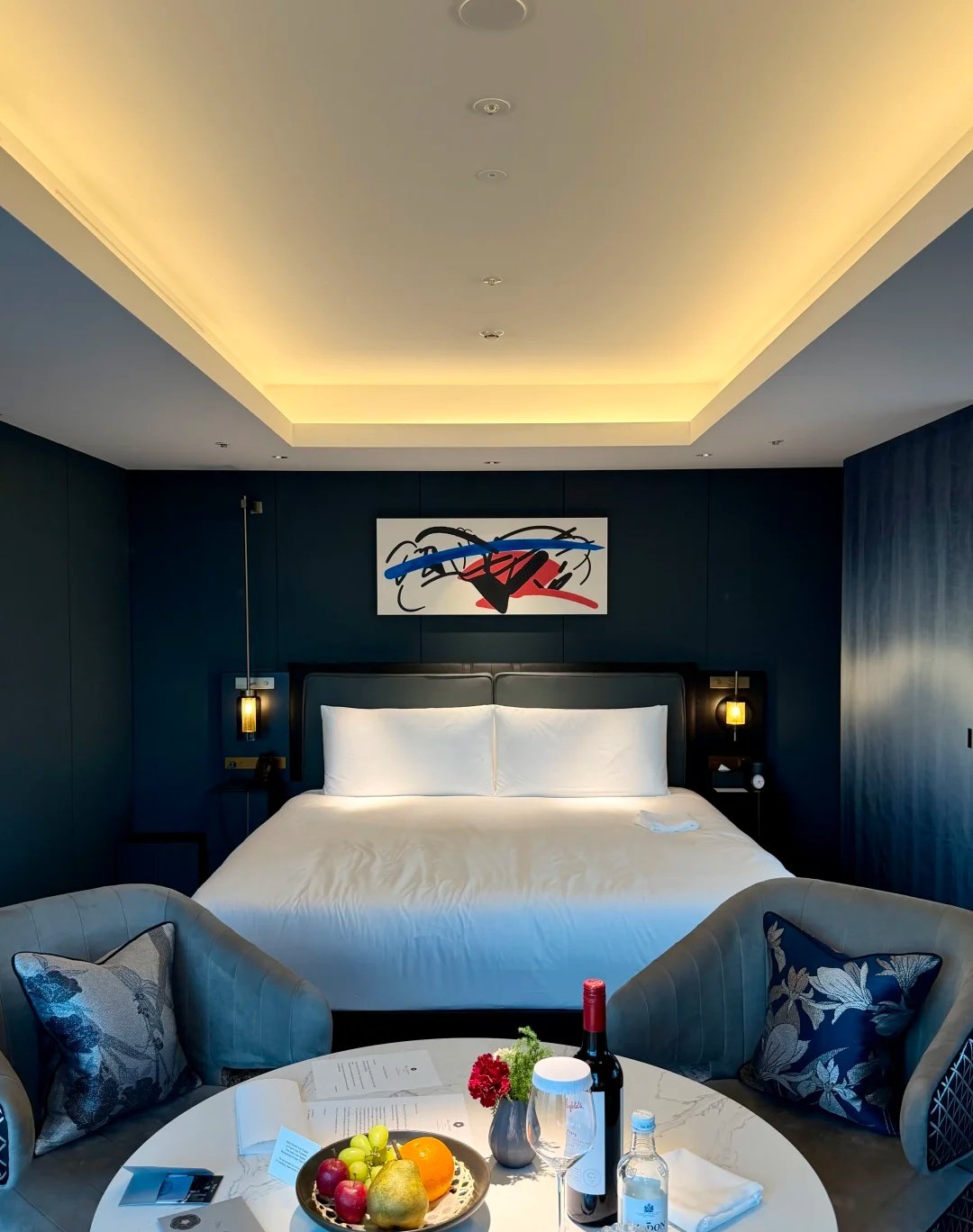
I stayed in a Junior Corner Suite King on a high floor.
Arrival
The arrival is the weakest thing about Bellustar, and it still hasn't been fixed. The entrance is on the side of the tower, near the passage from Seibu-Shinjuku station, and it's marked by a large folding-screen mural. Miss it and you'll end up at the desk of Hotel Groove, the 538-room tour-group hotel that shares the building.
At street level someone takes your bags, hands you a welcome drink and rides up with you to the lobby on 18. Only one lift does that run, for the whole hotel, and it's slow. On 18 you change lifts again for the room floors. By taxi it's worse, because cars drop off in the basement. Tell the driver "Kabukicho Tower".
There's no reception desk. I checked in sitting down, on an iPad, with a member of staff kneeling beside me. Because arrivals are brought up one party at a time, the lobby is usually empty of guests and full of staff watching the lifts. It's private, but stepping out into a room of people who've all been waiting for you felt a bit like walking into a surprise party where nobody remembered to hide.
Once you know the building, use the back way: take a Groove lift to their lobby on 18, walk through the gym and go through the unmarked door into Bellustar. Check-in is 15:00, and with GHA status an early room is likely.
Leaving is the opposite story, and it's brilliant. My bags were collected on time to the minute and were already in the taxi when I came down.
The room
Book a corner, then pick your side. The rooms are why you stay, and they're very large for Tokyo. The entry Studio King is 41 to 48 square metres, most categories are 51 to 59, and every room has a floor-to-ceiling window about seven metres wide.
Bathroom
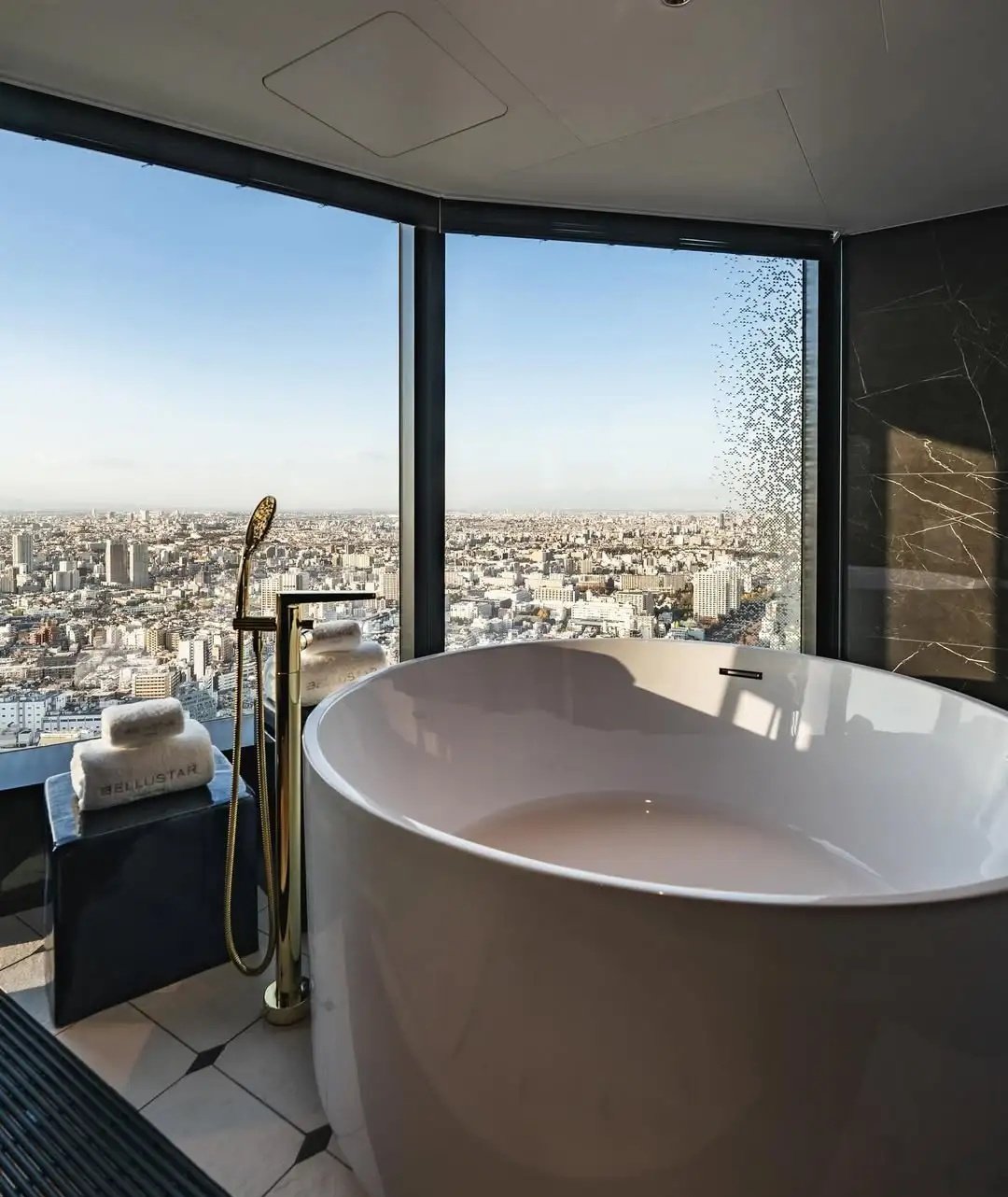
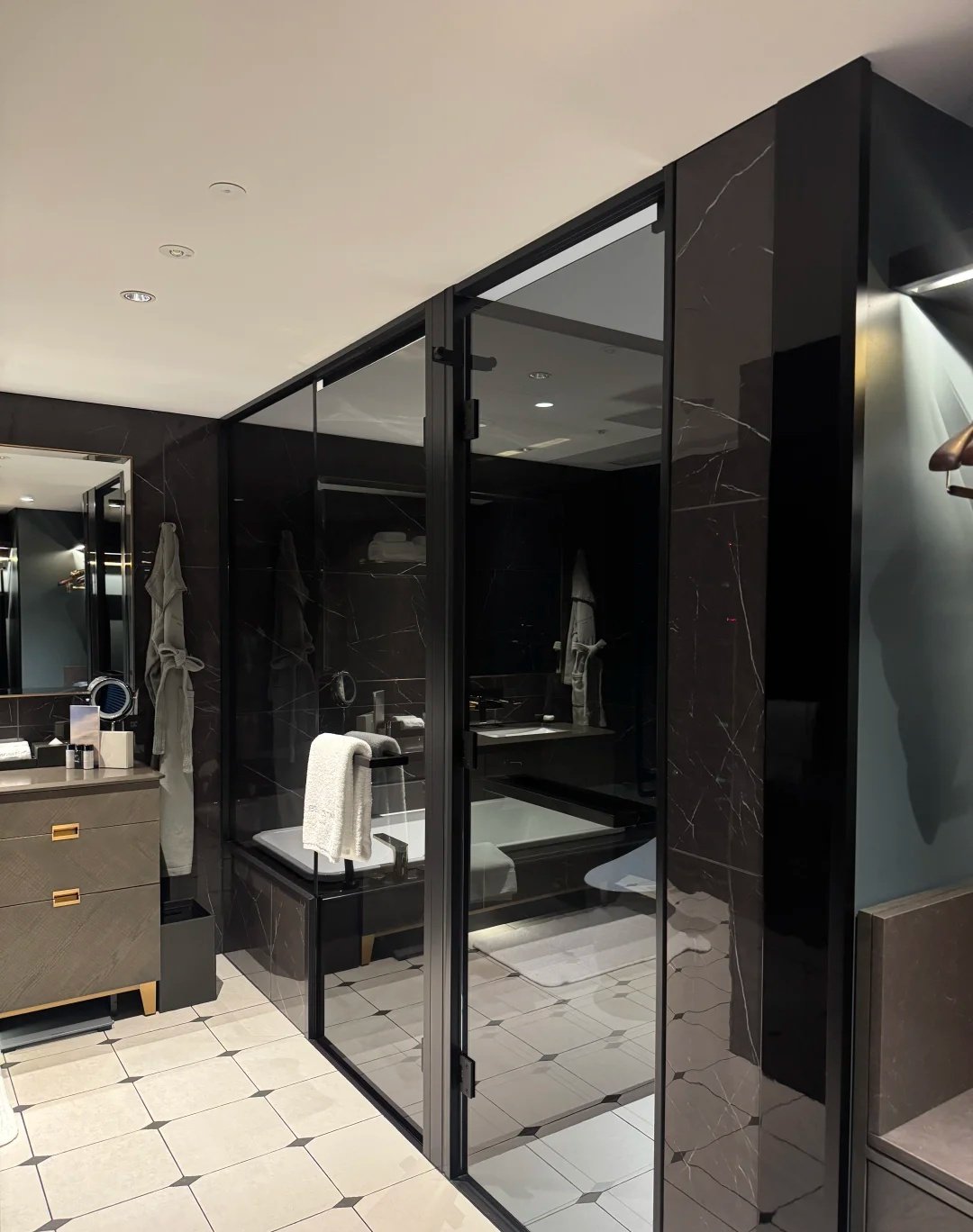
My Junior Corner Suite King was 59 square metres, with a round tub right against the glass. Lying in that tub at night with Tokyo lit up below is the best thing in the hotel, and I'd book the room for the tub alone. The bathroom walls are glass, though, so it only really works for a couple.
Which side to book
The bigger decision is which way you face.
- West gets Mount Fuji on clear days and the Shinjuku skyscrapers. It also gets the Seibu-Shinjuku tracks, which you can hear from early morning to late night, and some taller towers cutting into the view.
- East gets the Skytree and Tokyo Tower, but it faces the Kabukicho bar streets, and sirens carry up into the 40s at night. The Junior Corner Suites face this way.
The noise is faint, and I slept fine with earplugs, but if you're a light sleeper I'd stay elsewhere. Whichever side you pick, go as high as you can.
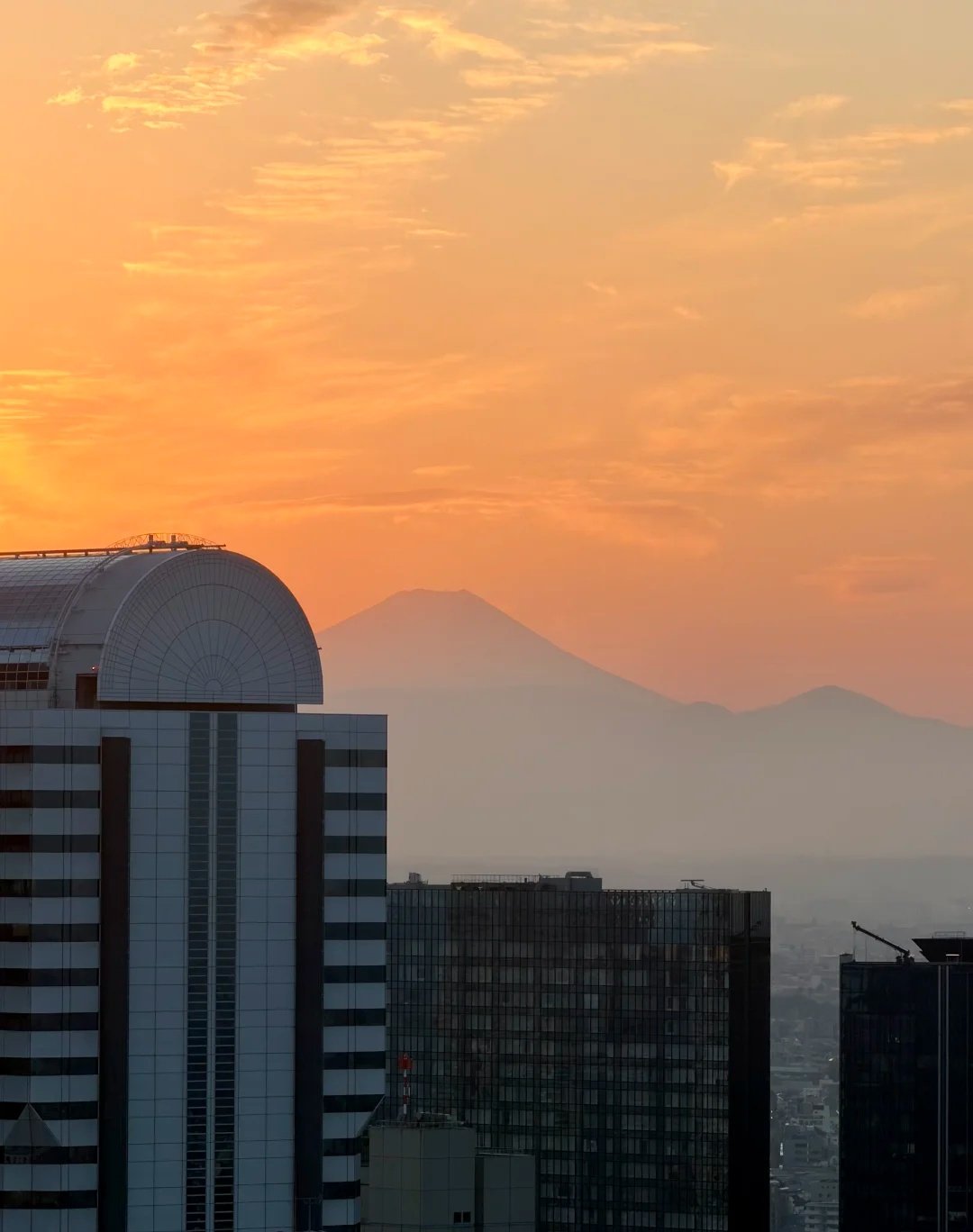
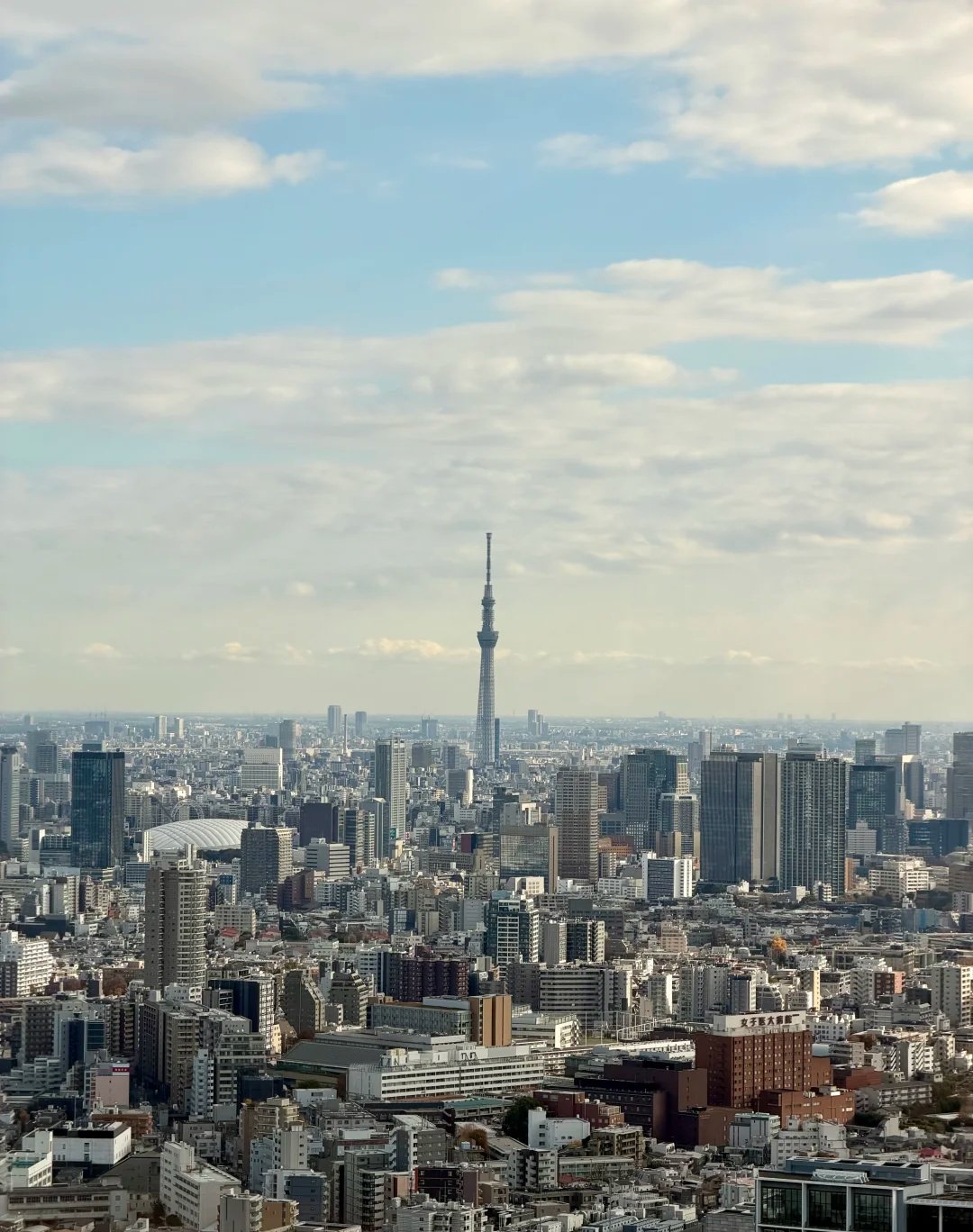
If you're taking photos, the glass has a white dot pattern near the edges that shows up on camera, so shoot from the middle of the window.
Bedroom
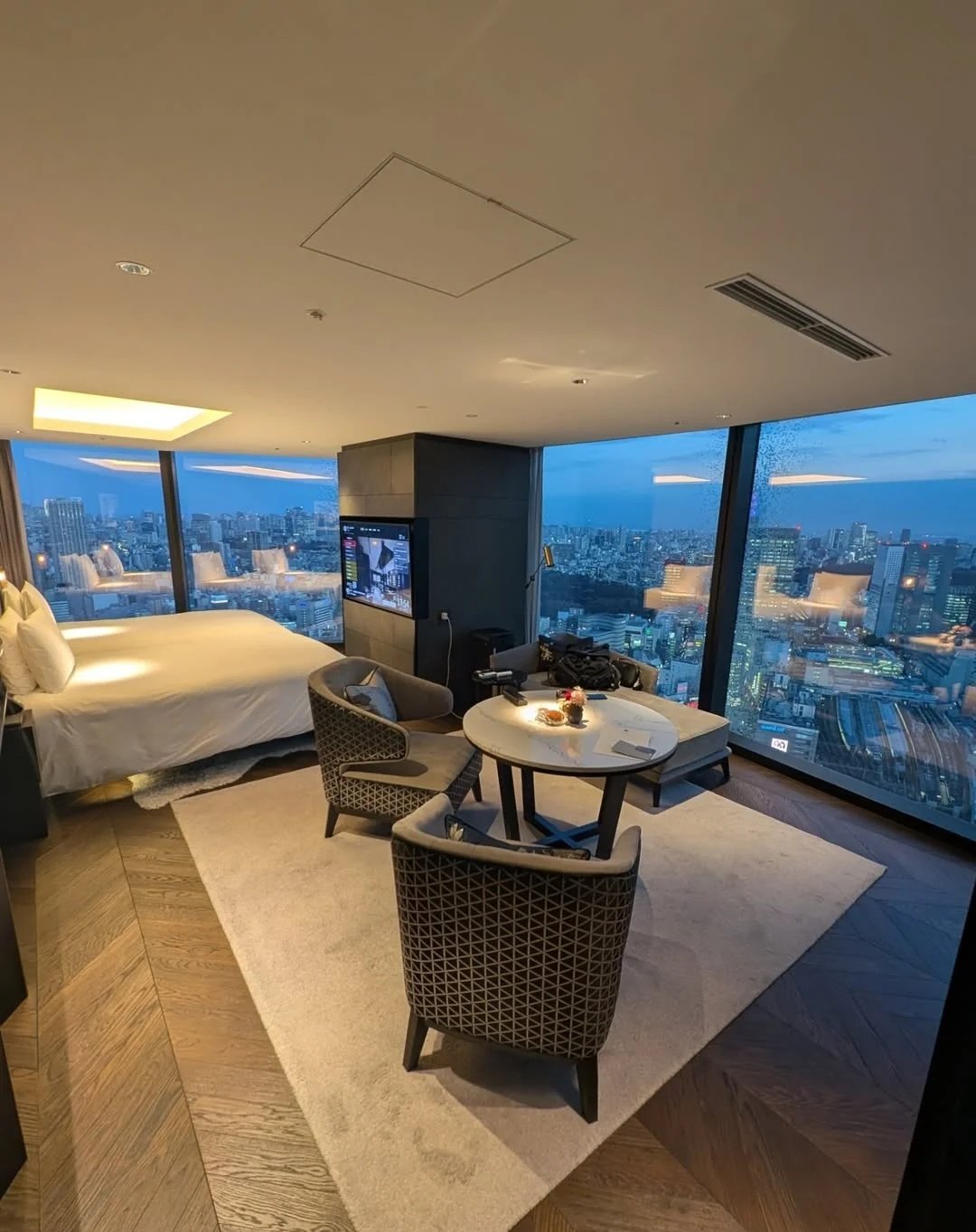
The design is dark and nearly monochrome, with a black-marble look in the bathroom and hardwood floors. It looks sharp at night and a little gloomy by day. The finish is a notch below the newer Four Seasons hotels, but that's about the feel of the place; nothing in my room was worn or chipped, and it was spotless.
Other rooms and suites
One quirk matters if you have status: the twin version of a room counts as a category above the king here. Two smaller beds outrank one big one, which is the kind of maths only a hotel could come up with. It means a "two-category" elite upgrade from a king may move you only one real room type, or into a twin. If you want a king, say so.
The room I'd avoid is the Studio Premier Twin. The tub and shower sit behind black glass doors, and you can hear and half-see whoever is in there. For not much more, a suite is the better buy. If you're a family, look at the Two Bedrooms Deluxe Suite: 82 square metres, two king beds and two bathrooms, which is rare in Tokyo.
Service
The service is the most Japanese thing about Bellustar. It's formal and anticipatory, and more rigid than at a Four Seasons. The individual staff are very good, but the systems behind them aren't there yet.
Housekeeping is the star. Every time I came back, the room was spotless and the things on my desk had been lined up neatly. Turndown brings ice, water and a Tottori honey cookie, and shoe shining is free. Room service reached me in about fifteen minutes.
Where it slips is the paperwork. Billing mistakes and missed status are common here, and they only get fixed when you raise them. Give your GHA number at check-in, and check both the breakfast charge on your folio and your bar bill. The bar is lit beautifully for a sunset and badly for reading what you're signing, and a ¥3,000 round has come back as a ¥20,000 bill before.
The concierge handled ordinary restaurant bookings well by email, but for the hardest tables in town I wouldn't rely on it. They'll take in luggage you've forwarded ahead, but they don't ship it on to your next hotel. English is good at the front and uneven elsewhere, and there are Chinese-speaking staff.
Breakfast
Breakfast is good, small and a little chaotic when it's full. It's served on 45 in Restaurant Bellustar from 07:00 to 10:00, and instead of a buffet you pay a fixed price and order as much as you like from the menu. My advice: come at seven and order the croissant.
The croissant is the best hotel croissant I've had in a long while, and the brioche French toast is like a set custard inside, though the eggs Benedict are ordinary. There's no rice in the restaurant. This is Japan, and rice has been sent to its room: the Japanese OKAMOCHI set only comes as room service.
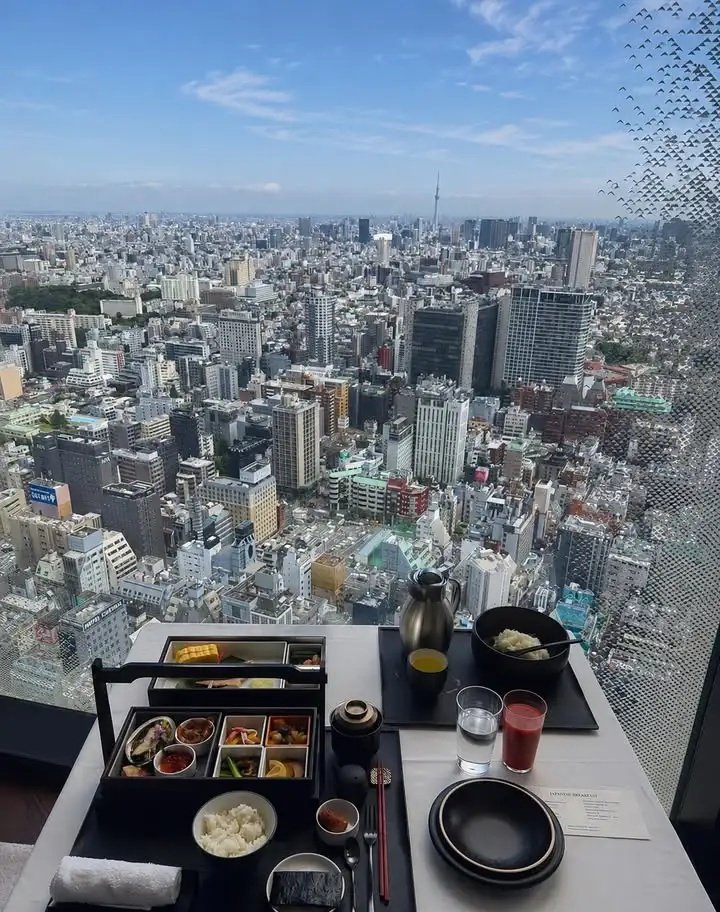
The restaurant is small, so the window tables go to whoever turns up at seven, and later on tables get forgotten. Breakfast in your room arrives on time and is just as good, though the studios have no proper table to eat it at.
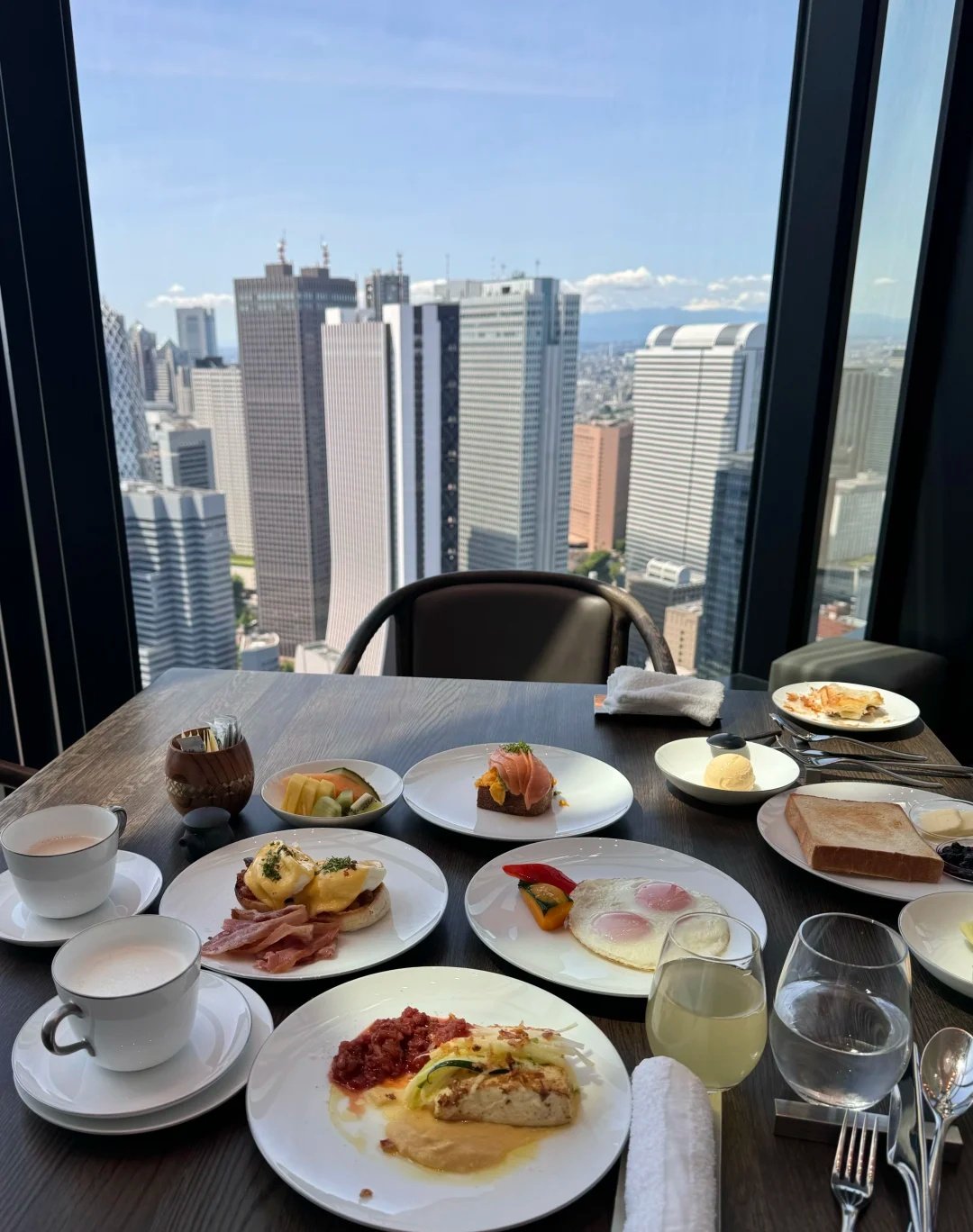
If breakfast is in your rate, as it is for GHA Titanium members, have it. If you're paying, a set is about ¥7,000, and à la carte eggs alone are ¥3,000. I'd rather grab an egg sando from the 7-Eleven downstairs and take it up to the free lounge on 46, which opens at 08:00. Skip the Groove's buffet, which is busier and worse.
Restaurants and bars
The best eating is at the two small counters, and the flagship French restaurant is the weakest part of the food.
Restaurant Bellustar
Restaurant Bellustar is modern French with regional Japanese produce, under chef Munehiro Takesue, in a 36-seat room under a 13-metre atrium. My fish was on the salty side, and so was the crab consommé, which tasted like the crab had brought some of the sea along with it. The wine pairing, heavy on Japanese wines, was a real pleasure. But at ¥30,000 to ¥40,000 a head, I think it's poor value. It holds no Michelin star; the Key belongs to the hotel.
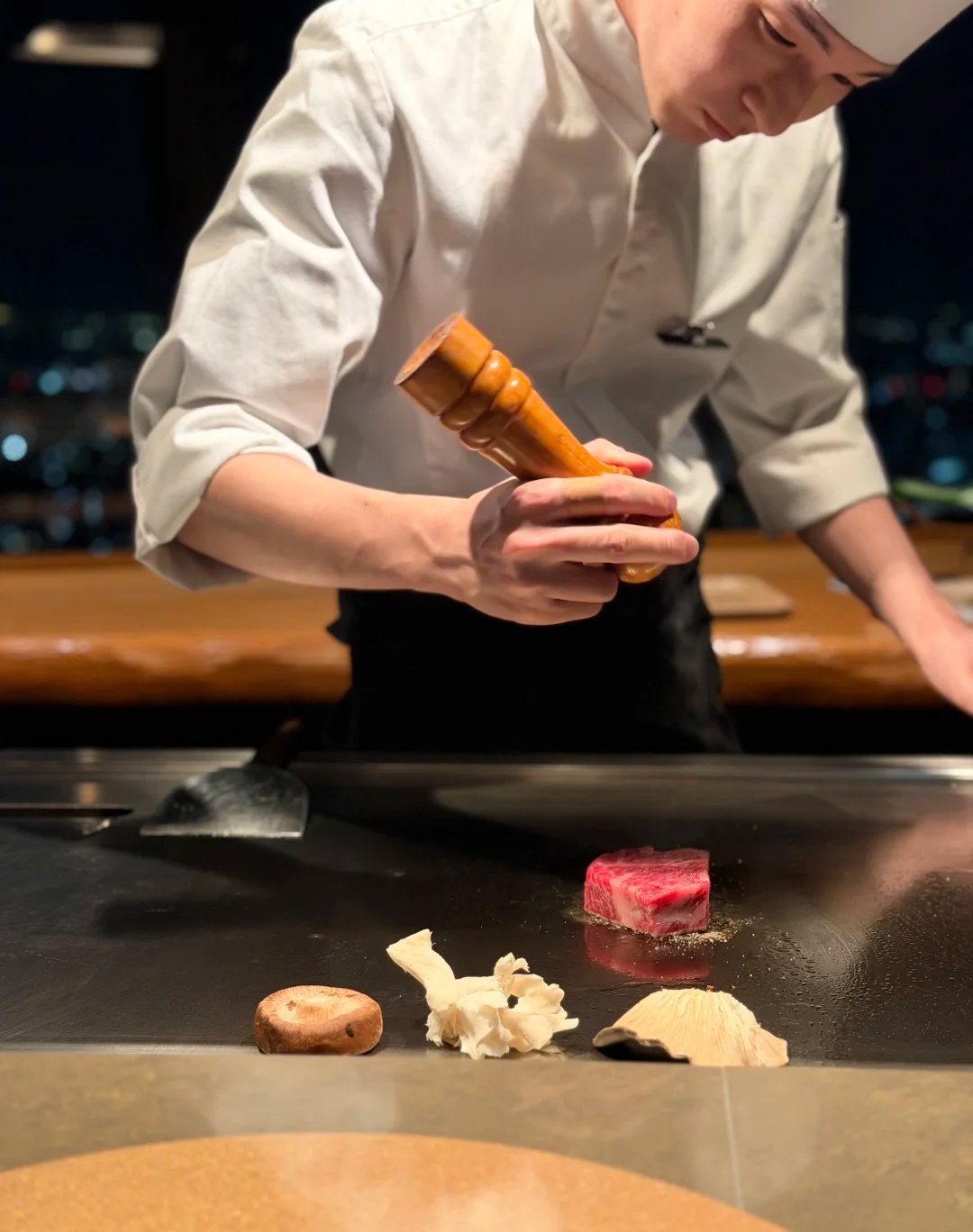
Teppan Ten-yu
Teppan Ten-yu has ten seats and costs about ¥25,000 a head. It's not cheap, but it's excellent, and it's the dinner I'd book.
Sushi JIN-È
Sushi JIN-È is a nine-seat Edomae counter, closed on Mondays. The omakase with a dozen-plus drink pairings is ¥45,000, which is fair for a hotel counter.
Bar Bellustar
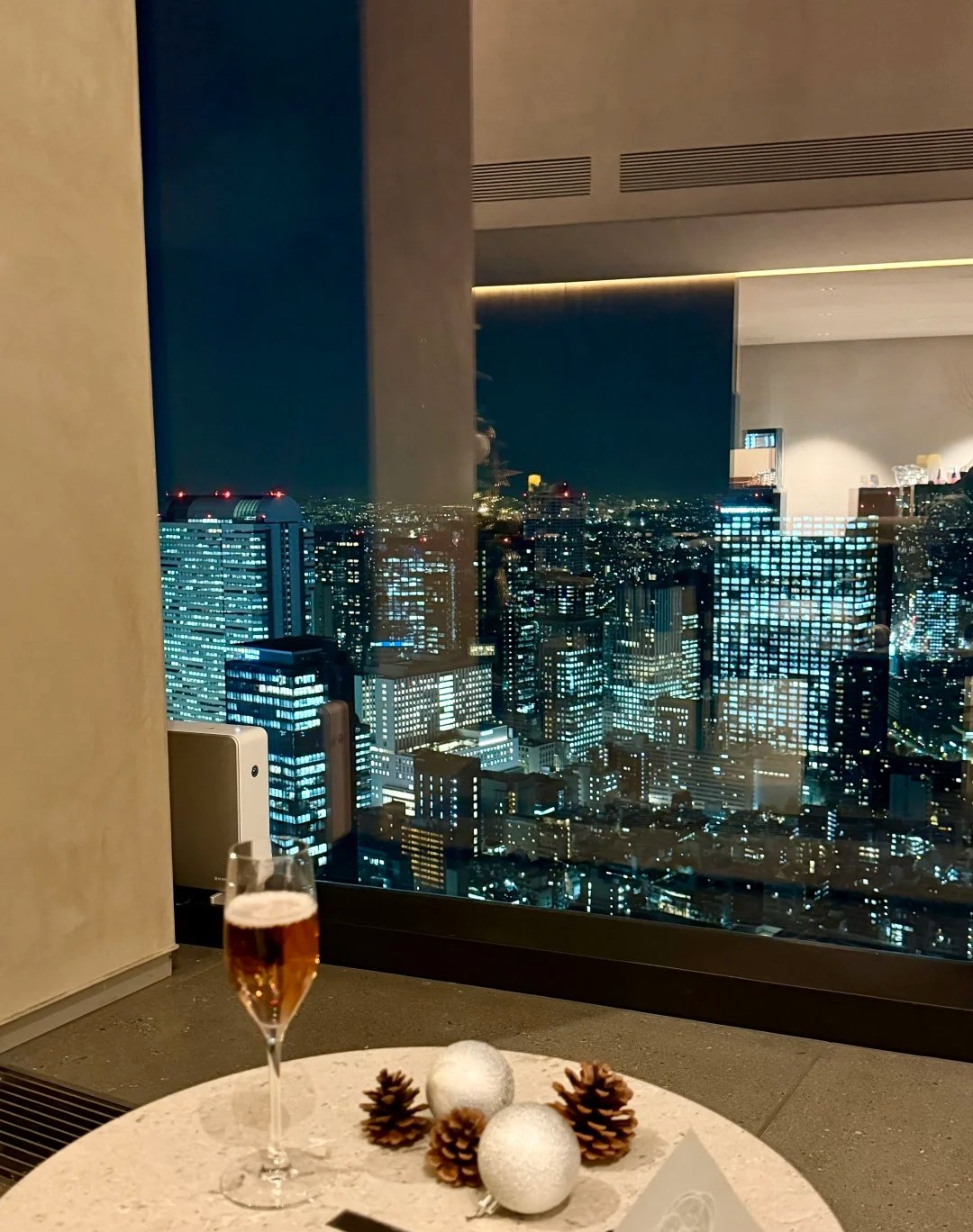
Bar Bellustar on 45 is the place to be at sunset. Cocktails are ¥2,200 to ¥2,700, the pours are small, and they charge for the nuts.
The lounge on 46
The lounge on 46 is free for every guest from 08:00 to 20:00, with self-serve beer and wine in the evening. It's basic, and nobody would call it a real club lounge, but free beer and wine with that view is worth having. In-room dining runs 24 hours.
Spa and gym
There's no pool, sauna or bath. The tower has a cinema, a theatre, a music venue, a nightclub and an arcade, and nowhere to swim. That's the real gap against Four Seasons Otemachi and the Park Hyatt. The 24-hour gym on 18 has city views and was empty both times I used it. There's a spa, SPA sunya, on 47.
Location and sense of place
The location is the best-connected luxury address in Shinjuku, and the most divisive. Seibu-Shinjuku is a minute away, and JR Shinjuku is seven to ten through the crowds. Golden Gai and Omoide Yokocho are within ten minutes. With the airport buses at the tower and the Romancecar to Hakone, it's an easy place to start a trip.
But this is Kabukicho. The plaza on the east side of the tower is where runaway teenagers gather at night, and it's littered by morning. Touts and host clubs start a little further east. Daytime is fine, even with children, but after about 22:00 I wouldn't take them. The easy fix is to walk south past the Shinjuku Prince to the station, and you'll miss almost all of it. Ginza and Marunouchi are a long way off, though.
As for feeling like you're in Japan, the art is good, including a Daido Moriyama photograph. But the rooms are international minimalism, and with a French restaurant and a Western breakfast, the only Japan here is the service manner and Shinjuku outside the window. For Japan inside the hotel, go to Hoshinoya Tokyo, Aman Tokyo or the Okura.
Is it worth it?
Yes. The corner suite is one of the best rooms in Tokyo, and the walk south to the station takes care of most of Kabukicho. I'd skip the entry studios for the suite, and I wouldn't bring young children. Don't come for a pool or Palace-level polish, because there's no pool and the polish isn't there yet.
Rates start at about ¥85,000 for a Studio King, ¥125,000 for the Junior Corner Suite King and ¥265,000 for the two-bedroom suite, plus 15% service, 10% tax and city tax. The hotel has held one Michelin Key since 2024, which feels right to me: the room is very strong and the hotel around it is still catching up.
Against its rivals, Bellustar wins on room and view and loses on almost everything else. Four Seasons Otemachi has smaller rooms but a pool, an onsen, better food and more consistent service. At suite prices you're into Palace Hotel and Okura money, and both are better run. Park Hyatt Tokyo, reopened in December 2025 from about ¥120,000, has the pool and the name. Bellustar is cheaper, newer and closer to the station.
I'd book it if you're a couple or friends who want Shinjuku at night and a big room above it, ideally as the first leg of a trip before Hakone. It also suits view-chasers, GHA Titanium members and families with teenagers.
I'd book something else if you have young children or grandparents with you; Four Seasons Otemachi is the one for that. The Palace Hotel Tokyo is better for a calm first visit, Hoshinoya Tokyo or Aman Tokyo if you want a Japanese atmosphere, and the Park Hyatt if you want Shinjuku with a pool.
If you go, book the Junior Corner Suite King, as high as you can get, for the window tub.
At a glance
| Best for | Couples and friends who want Shinjuku nightlife, view-chasers, a first leg before Hakone, families with teenagers in the two-bedroom suite, GHA Titanium members |
| Not for | Young children, light sleepers, pool and spa people, anyone wanting Japanese atmosphere or Palace-level polish |
| Room to book | Junior Corner Suite King, high floor; Two Bedrooms Deluxe Suite for families |
| Room to avoid | Studio Premier Twin, for the glass-door bathroom; low floors on either side |
| Skip | Paid breakfast, dinner at Restaurant Bellustar, the Groove's breakfast buffet |
| Don't miss | The window tub at night, the croissant at 07:00, Teppan Ten-yu, sunset in the bar, the free lounge on 46, the walk south past the Shinjuku Prince |
| Rough nightly rate | From about ¥85,000 (Studio King) and ¥125,000 (Junior Corner Suite King), plus 15% service and 10% tax |